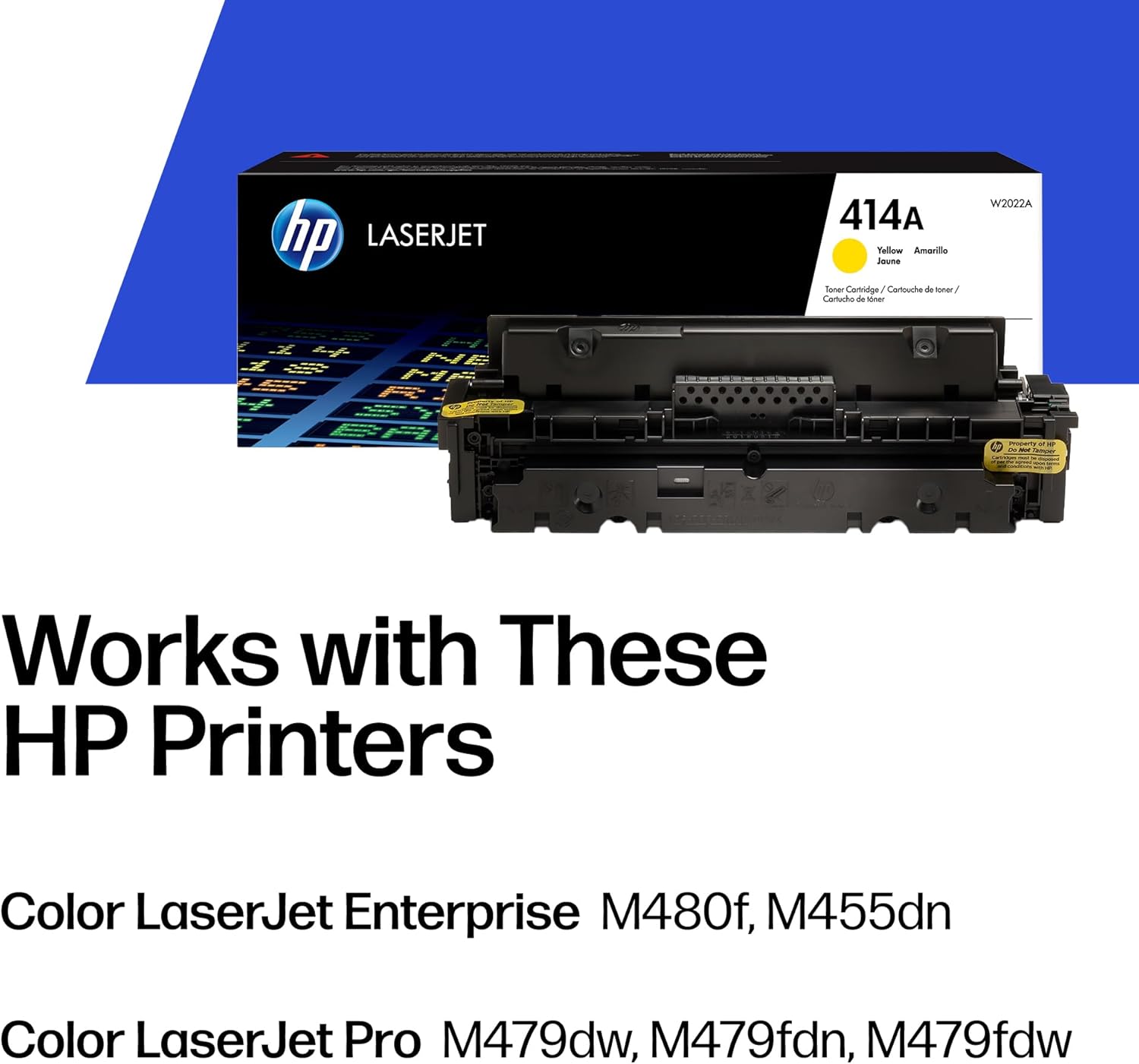
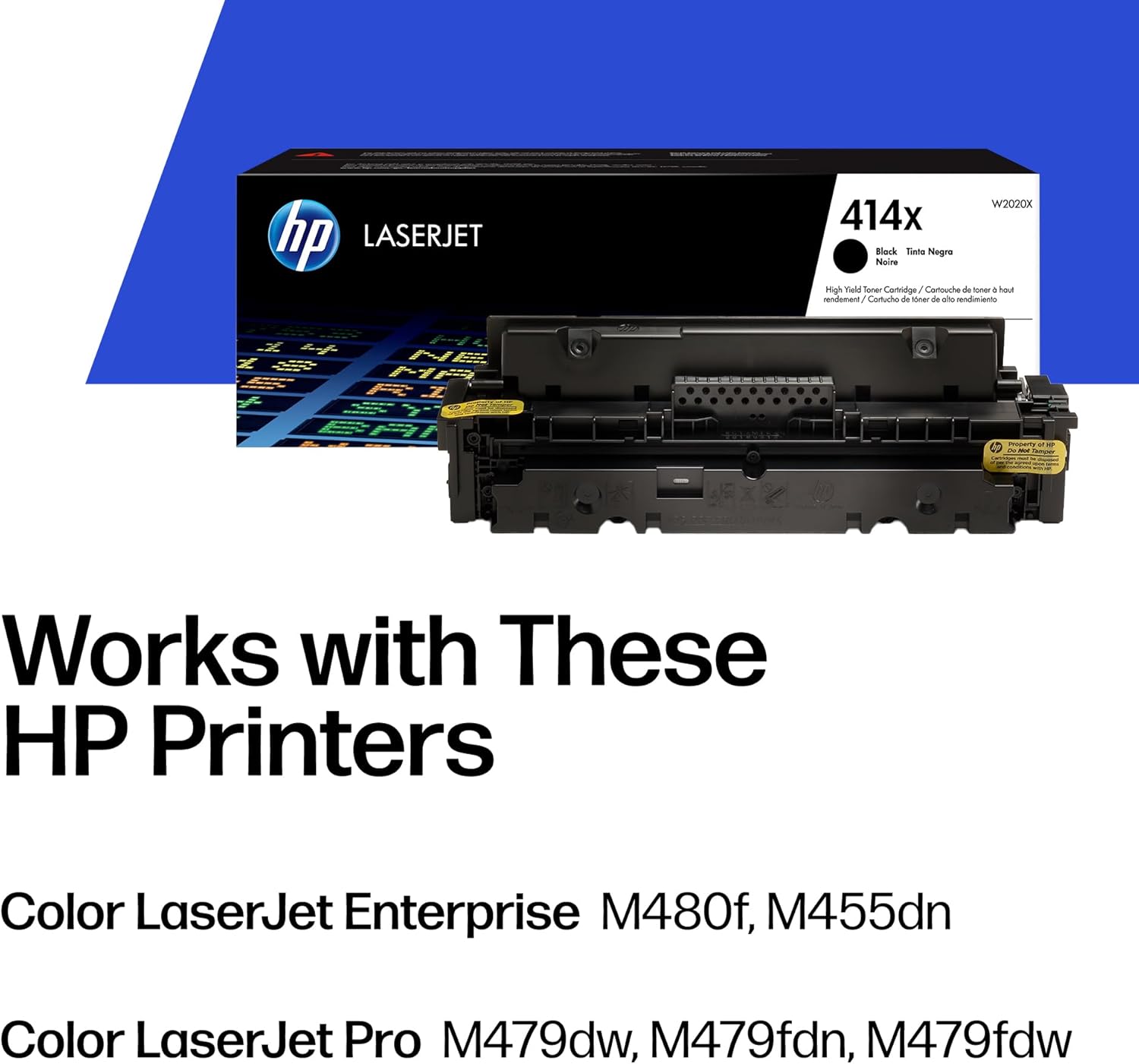
If your M454 or M479 just threw a low-toner alert and you’re staring at a product page showing two versions of what looks like the same cartridge — one labeled 414A and one labeled 414X — you’re in the right place. The letter at the end is the key difference: A is the standard-yield cartridge, meaning it prints a set number of pages before running out, and X is the high-yield version — same toner chemistry, more toner packed in, more pages per cartridge. The HP Color LaserJet Pro M454 and M479 series are mid-to-upper-range color laser printers designed for small offices and workgroups that need consistent, professional color output. This article walks you through the yield math on both cartridge tiers, lays out what you gain or give up by choosing compatible aftermarket alternatives, and ends with a straightforward decision rule for wherever your fleet sits right now.
414A vs. 414X: The Yield and Price Math You Need
Let’s anchor everything in published specs first, because the numbers drive every downstream decision.
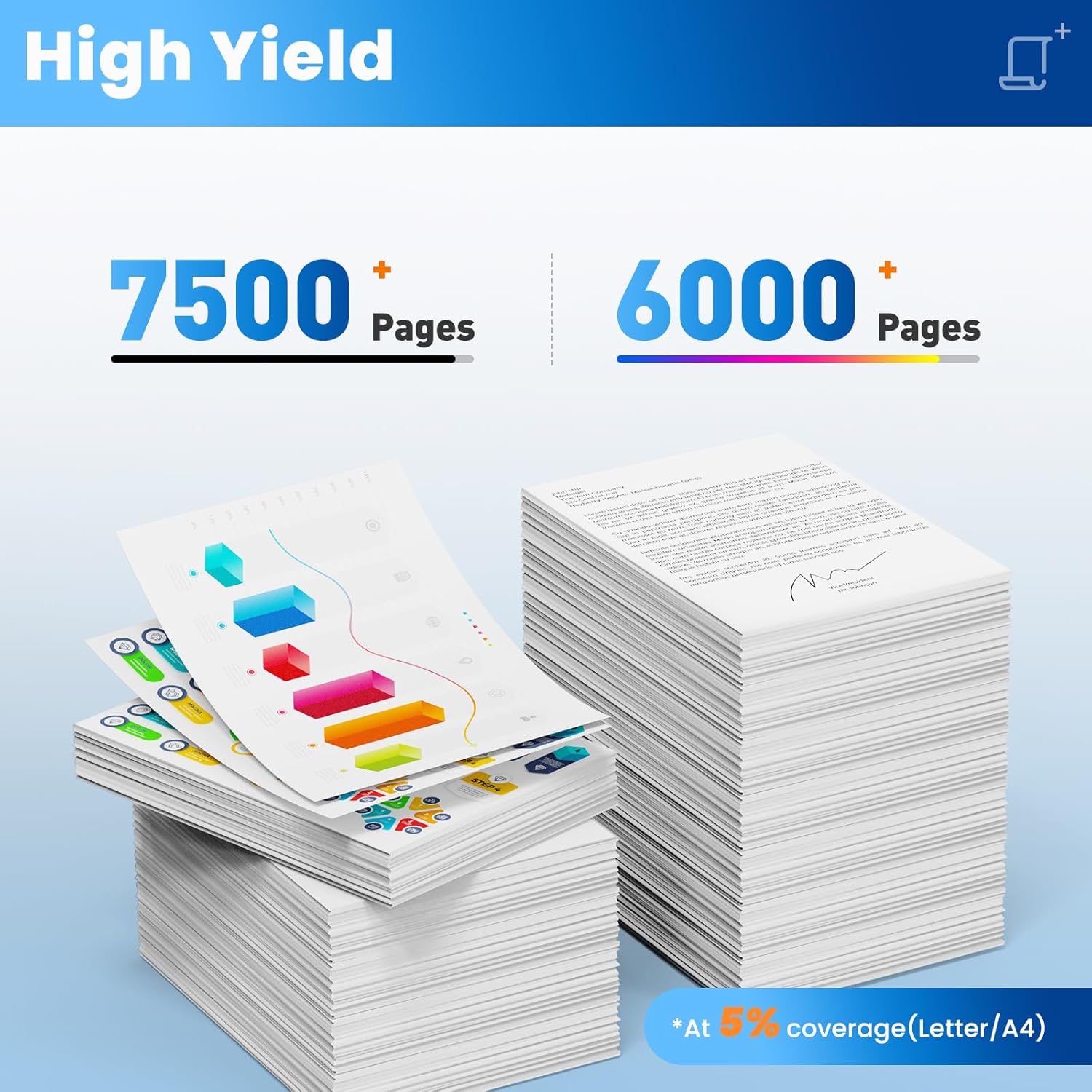
HP’s official product specifications list the following ISO-tested page yields for the 414-series cartridges (source: HP Inc., HP 414A and 414X Toner Cartridge Product Specifications datasheet):
| Cartridge | Color | Standard Yield (414A) | High Yield (414X) |
|---|---|---|---|
| Black | W2020A / W2020X | ~2,400 pages | ~7,500 pages |
| Cyan | W2021A / W2021X | ~2,100 pages | ~6,000 pages |
| Magenta | W2023A / W2023X | ~2,100 pages | ~6,000 pages |
| Yellow | W2022A / W2022X | ~2,100 pages | ~6,000 pages |
(Yields measured at 5% page coverage under ISO/IEC 19798 conditions, per HP Inc. 414A and 414X Toner Cartridge Product Specifications.)
OEM street pricing, May 2026:
- 414A black (W2020A): ~$55–$65 per cartridge
- 414X black (W2020X): ~$110–$130 per cartridge
- 414X color (single, any color): ~$95–$115 per cartridge
- 414X 4-cartridge set: ~$380–$430 OEM retail
Now let’s run the cost-per-page (CPP) math on black toner, since that’s typically your highest-volume color:
- 414A at $60: $60 ÷ 2,400 pages = $0.025 per page
- 414X at $120: $120 ÷ 7,500 pages = $0.016 per page
That’s a 36% reduction in CPP just by moving from standard to high-yield — and you haven’t touched the cartridge brand yet. If you’re running even a modest 1,500 pages per month across a two-printer fleet, the 414X pays for its premium within roughly six weeks of use. The math compounds fast at higher volumes.
For color cartridges, the gap is slightly narrower — a 414A color at ~$50 and 2,100 pages equals $0.024 per page versus a 414X color at ~$105 and 6,000 pages equals $0.0175 per page — but the direction is identical: high-yield wins on CPP every time, assuming your monthly volume actually consumes a cartridge within 12–18 months. Toner does have a practical shelf-life once installed in the drum environment.
Comparing Your Options: OEM Standard, OEM High-Yield, and Compatible
OEM Standard-Yield 414A — Best for Low-Volume Single-Printer Use
The 414A is HP’s entry point for the M454/M479 consumable stack. Its lower upfront price is genuinely useful for one specific user type: a home office or very small workgroup running under 500 pages per month, where a high-yield cartridge would sit in the machine long enough for toner quality to degrade before the cartridge is finished.
PCMag’s review of the HP Color LaserJet Pro MFP M479fdw (PCMag, HP Color LaserJet Pro MFP M479fdw Review) highlights the platform’s color output quality as a standout characteristic, noting the printer’s accuracy across mixed document types. That output quality is easiest to maintain at low volume on fresh OEM cartridges, even standard-yield ones, because toner age and drum exposure are minimal.
The downside is pure CPP math: at $0.025 per page for black, you’re paying a significant premium per page versus high-yield alternatives. For anyone printing more than 700 pages per month consistently, the 414A’s lower ticket price becomes a false economy within one cartridge cycle.
HP
$150.89
In stock on Amazon
Check price on AmazonOEM High-Yield 414X — Best for Mid-Volume Workgroups and Color-Critical Environments
The 414X is the workhorse of the 414-series line for office fleets. At $0.016 per page for black and approximately $0.0175 per page for color, it delivers the best CPP of any OEM option on the M454/M479 platform.
The case for OEM high-yield over compatible high-yield comes down to three factors: yield predictability, color fidelity, and firmware risk management.
Yield predictability. HP’s ISO-tested page yields are verified under controlled conditions by independent testing organizations. Keypoint Intelligence (formerly Buyers Laboratory), in their 2025 Aftermarket Toner Quality Benchmarks report, consistently identifies HP OEM cartridges as meeting or exceeding stated yields in real-world mixed-duty environments. When you’re managing a fleet and forecasting supply spend per quarter, that predictability has real budget value — you’re not recalibrating your reorder cadence because a batch of cartridges ran short.
Color fidelity. The M454 and M479 are used heavily in design-adjacent workgroups — marketing teams, real estate agencies, architectural firms — where color output is a business deliverable. HP engineers the 414-series toner chemistry to work with the M454/M479’s image transfer system and ICC profiles, which are the standardized color data sets that tell your printer how to reproduce a specific hue accurately. PCMag’s M479fdw review specifically calls out color accuracy as a standout strength of the platform. That accuracy is calibrated to OEM toner; third-party toner can shift white-point balance or introduce subtle hue drift that only becomes visible when matching brand colors across a print run.
Firmware risk. HP has a documented history of pushing firmware updates that tighten cartridge authentication checks. TechRadar’s review of the HP Color LaserJet Pro M454dw (TechRadar, HP Color LaserJet Pro M454dw Review) notes that HP’s supply monitoring is deeply embedded in the printer’s firmware layer. If your M454 or M479 receives an automatic firmware update while running non-HP cartridges without a current chip workaround, you may encounter supply errors mid-run. OEM cartridges are always firmware-safe by definition.
HP
$235.89
In stock on Amazon
Check price on AmazonCompatible High-Yield 414X Equivalents — Best for Budget-Conscious Mid-Market Fleets
Here is the honest version: compatible toner from reputable third-party manufacturers has improved meaningfully over the past three years, and the CPP advantage is substantial enough to take seriously — especially for mid-market fleets where color-criticality is moderate.
The CPP gap. Compatible 414X-equivalent cartridges from established suppliers — Katun and Clover Imaging Group both manufacture to commercial tolerances and carry ISO 9001 certification — typically run 40–55% below OEM pricing. A compatible 414X black in the ~$55–$70 range at the same 7,500-page yield drops CPP to roughly $0.007–$0.009 per page. On a 10-printer fleet printing 15,000 pages per month in black, the annual delta against OEM pricing is substantial.
Keypoint Intelligence’s 2025 Aftermarket Toner Quality Benchmarks report evaluated compatible cartridges across HP Color LaserJet platforms and found that top-tier compatible suppliers — specifically those producing cartridges with original-specification chip sets and virgin (new, not recycled) toner powder — matched OEM output quality at commercially acceptable levels for general business documents. The gap appeared most in sustained high-coverage color printing, where toner adhesion and fuser compatibility matter more.
The warranty question. HP’s standard warranty language states that using non-HP toner does not automatically void your printer warranty — Magnuson-Moss Warranty Act provisions in the U.S. protect consumers here. However, HP can decline warranty service for a specific failure if they can demonstrate the compatible cartridge caused the damage. Office Technology Magazine’s OEM vs. Compatible Toner: Total Cost of Ownership Analysis (2025) notes that cartridge-attributed failures are rare and difficult to prove in practice, but the risk is non-zero in heavily loaded print environments where fuser assembly wear is a real cost factor.
Where compatibles fall short. Three specific scenarios favor OEM regardless of price:
-
Color-critical output. If your M479 is producing client-facing materials where Pantone-adjacent color matching matters, OEM is the safer call. Compatible toner can introduce subtle gamut shifts, particularly in saturated reds and warm neutrals, that are invisible in a single print but inconsistent across a run.
-
Post-firmware-update environments. If your M454 or M479 fleet is set to auto-update firmware — check Settings > Printer Maintenance > Firmware Updates — compatible cartridges with older authentication chips may throw supply errors after an update cycle. Reputable compatible suppliers do push chip updates, but there is typically a lag. If you’re running compatibles, manage firmware updates manually rather than automatically.
-
Managed print service (MPS) agreements. If your printers are under an MPS contract where the service provider manages supplies and billable page counts, using non-OEM toner may violate contract terms. Check your SLA language before switching.
414X
$299.99
In stock on Amazon
Check price on AmazonDecision Rules: If X, Then Y
This is where everything above collapses into actionable guidance.
If your monthly print volume per printer exceeds 1,000 pages and you’re still buying 414A standard-yield cartridges: Switch to 414X immediately. The CPP math doesn’t leave room for debate — you’re paying a 50%+ premium per page for the convenience of a lower upfront cartridge price. At 1,000 pages per month, you’ll exhaust a 414A black in under three months anyway.
If you’re running a 2–5 printer fleet, color output is business-standard rather than brand-critical, and budget pressure is real: A premium compatible line — Katun, Clover Imaging, or LD Products’ commercial-grade 414X equivalents — is worth evaluating. Run a parallel comparison on one printer for 30 days. If output quality holds at your use case and your firmware is manually managed, the 40–55% CPP reduction is defensible.
If you’re in a managed print service contract or your printers auto-update firmware: Stay OEM for now. The contract risk and chip-compatibility uncertainty are not worth the CPP savings until you’ve confirmed your MPS terms and locked down firmware management.
If you’re a design or marketing studio running the M479 for color-critical document output: OEM 414X is the default. The ICC fidelity argument holds, and the CPP difference between OEM and compatible narrows when you factor in the cost of reprints caused by color inconsistency.
If you’re a home office user running a single M454 at low volume (under 500 pages per month): The 414A standard-yield OEM cartridge may actually serve you better than 414X, because toner has a practical in-use shelf life. A high-yield cartridge that takes 15 months to exhaust in a low-volume machine may degrade before it’s finished. In this scenario, a reputable compatible 414A-equivalent from LD Products or a similarly established supplier in the $20–$35 range is a reasonable choice for internal documents.
Your Next Step
Pull your printer’s built-in supply usage report — on the M454 or M479, go to Reports > Supply Status — and note your average monthly page counts by color channel. That single number tells you whether you’re in 414A or 414X territory, and whether your CPP math supports OEM or opens the door to a compatible trial.
If you want to shop both options side by side with current pricing, the toner buying guides on this site include model-specific filters for the M454 and M479 — you can sort by yield tier and OEM-versus-compatible to find the right fit for your volume and budget.